Four decades have passed since the Filipino people ousted the Marcos Sr. dictatorship on February 25, 1986. Known as the EDSA People Power uprising, millions took to the streets nationwide to oppose the regime’s abuses of power, plunder, and fascist violence.
Forty years later, from Marcos Sr. to Marcos Jr., the rot in government remains. Those who hold power continue to use the state as a tool for exploitation, repression, and human rights violations. Entrenched traditional politicians, who work in concert with favored comprador capitalists and big landlords, still treat government as a business enterprise. This system is known as bureaucrat capitalism.
Bureaucrat capitalism flourished under the Marcos Sr. dictatorship. The regime’s monopoly over state power enabled Marcos Sr. to exploit government projects funded by foreign debt on a massive scale. He awarded large contracts to allied and favored businesses, foreign corporations, and banks, plunging the country deeper into debt and poverty.
Debt-funded regime
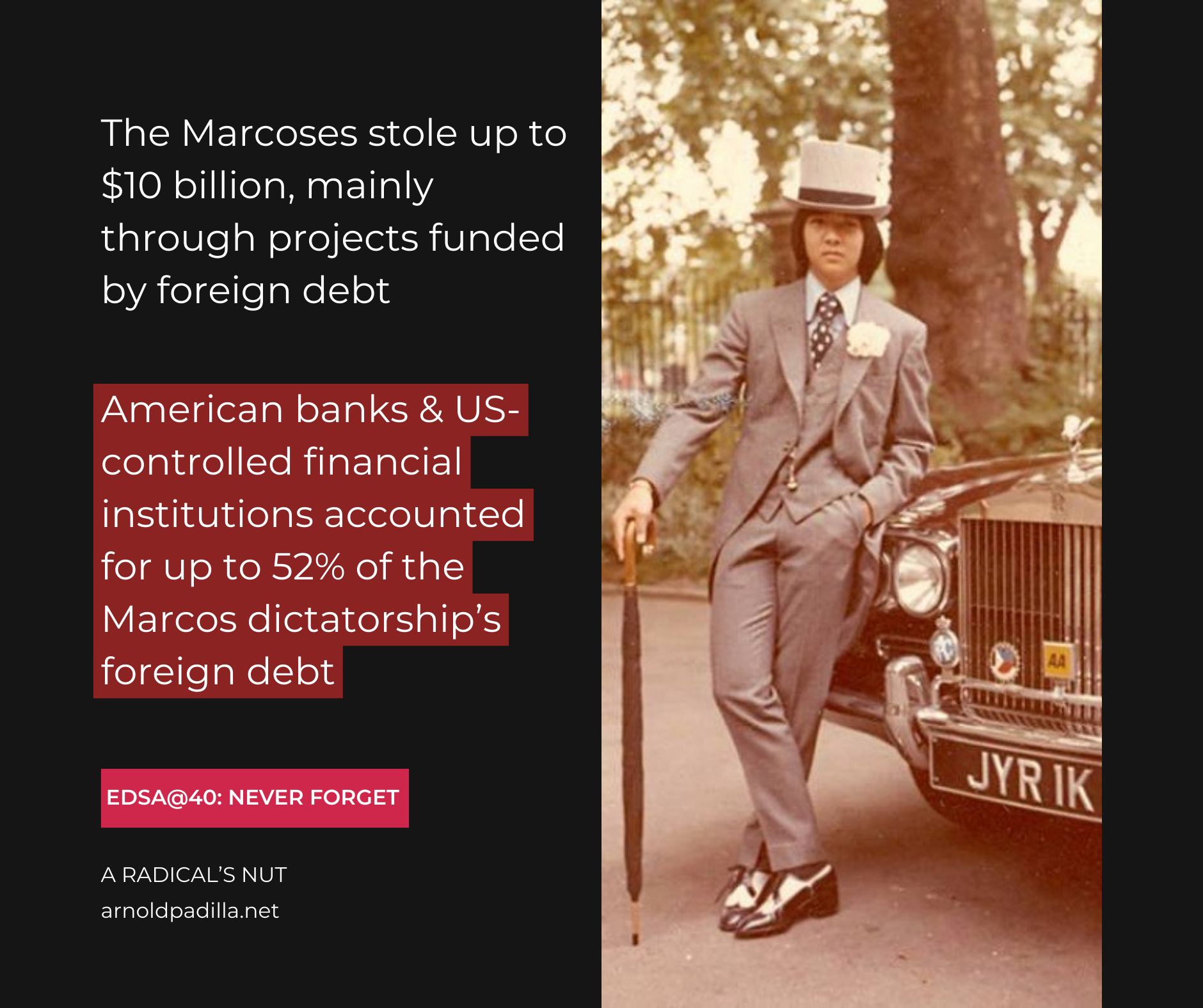
During Marcos Sr.’s rule from 1965 to 1986, the Philippines’ foreign debt ballooned by as much as 47 times. The Marcos family and their cronies siphoned off a large portion of this through anomalous projects. By the time Marcos fled in 1986, the country’s foreign debt had reached roughly $26–28 billion, while the family’s estimated stolen wealth stood at up to $10 billion. The Marcoses thus became among the largest bureaucrat capitalists in Philippine history.
American banks and U.S.-controlled financial institutions accounted for more than half of the Philippines’ foreign debt accumulated throughout the Marcos Sr. regime. Using available data, we can estimate that the U.S., directly through bilateral government loans and private American banks, and indirectly through U.S.-controlled multilateral financial institutions, provided the Marcos Sr. dictatorship up to $14.5 billion in loans, or as high as 52% of the total foreign debt that the Philippines has incurred by the time the dictator was forced to leave Malacañang by the EDSA People Power.
A large portion of this amount came from the International Monetary Fund (IMF) and the World Bank, financial institutions established by U.S. imperialism after the Second World War as instruments to control the economies and finance of its neocolonies, including the Philippines. The IMF and the World Bank combined to provide $5.5 billion in loans to Marcos Sr. Bilateral foreign loans, including those from the U.S., such as the U.S. Export-Import Bank (EXIM) and other creditors backed by U.S. agencies, accounted for $3.5 billion. Private American banks, meanwhile, accounted for up to $5.5 billion. Major private U.S. creditors of the Marcos Sr. dictatorship include Citibank ($1.8 billion), Manufacturers Hanover ($489 million), Bank of America ($487 million), Chase Manhattan ($427 million), and Morgan Guaranty ($252 million).
Profiting from corruption
These U.S. creditors played a key role in many of the corruption-ridden projects implemented by Marcos Sr. and his cronies. The most notorious among these corrupt projects was the Bataan Nuclear Power Plant (BNPP). A white elephant built with $2.3 billion in loans guaranteed by the Marcos Sr. dictatorship (as encouraged by the IMF-World Bank to ensure creditor confidence), the project received substantial financing from the U.S. EXIM Bank, with the American firm Westinghouse Electric Corp. building the nuclear plant. The project originally cost $500 million but more than quadrupled over time amid allegations of overpricing, collusion, and payoffs involving the American contractor Westinghouse, Marcos Sr., and his crony, Herminio Disini. The dictator himself reportedly pocketed at least $80 million from the anomalous project. Built near major geological faults, the overpriced nuclear plant was never operated because of thousands of serious technical and safety issues. Overall, the BNPP incurred a debt burden of up to $4.6 billion for Filipinos, including principal and interest payments, with the U.S. EXIM Bank and other foreign creditors, Westinghouse, and Marcos Sr. and his cronies all reaping profits at the expense of the people and the economy.
Private U.S. banks also backed the operations of one of Marcos Sr.’s closest associates and biggest cronies, Danding Cojuangco. During the dictatorship, Danding used the coco levy fund (a tax imposed by the dictatorial regime on millions of coconut farmers) to acquire major corporate assets, most notably San Miguel Corporation (SMC). SMC and other coco levy-linked assets of Danding relied on offshore syndicated loans, including from U.S. banks such as Citibank, Chase Manhattan Bank, and Bank of America, to finance their operation and expansion. The same holds for other Marcos Sr. cronies. Roberto Benedicto, for example, held a monopoly over Philippine sugar exports during the dictatorship through the Philippine Sugar Commission and the National Sugar Trading Corporation, which were regular borrowers in offshore syndicated credit facilities in which Citibank, Chase Manhattan, Bank of America, and other U.S. banks were major participants. Infrastructure development, meanwhile, was monopolized by another Marcos Sr. crony, Rodolfo Cuenca, who headed the Construction Development Corporation of the Philippines (later renamed Philippine National Construction Corporation). Like Danding’s and Benedicto’s operations, Cuenca’s operations were supported by the same private U.S. banks and other foreign creditors (mainly from Japan and Europe) through offshore syndicated loans.
From Marcos Sr. to Marcos Jr.
When People Power overthrew the Marcos Sr. dictatorship 40 years ago, it marked a decisive act of mass political struggle. The uprising was the result of years of resistance to Martial Law and a corrupt, fascist regime, fought in defense of democratic rights. But what we must learn from EDSA is that the fight against corruption and human rights abuses is a fight against not one dictator and his clique; it should be a fight against an entire system (bureaucrat capitalism) being propped up by foreign interests (U.S. imperialism). We must learn this from EDSA to better grasp the political and economic realities that continue to beset the Philippines today, and to understand what we must do to advance genuine and lasting democratic reforms.
The absence of structural and truly democratic reforms following the EDSA People Power enabled the Marcoses to return to Malacañang without ever being fully held accountable. To date, an estimated $1 to $ 6 billion in stolen wealth remains unrecovered. Worse, as during his dictator father’s time, systemic plunder of the public coffers has continued under President Ferdinand “Bongbong” Marcos Jr. While his administration publicly claims to wage a campaign against corruption, particularly in flood control projects, Marcos Jr. himself is at the center of these anomalous schemes through his control over the national budget.
Upon assuming office, Marcos Jr. introduced the Baselined-Balanced-Managed (BBM) Parametric Formula, a funding mechanism for infrastructure projects, including flood control. Under this system, budget allocations are based on the “priorities” of presidential allies rather than public need. This enabled the rise of so-called “allocables,” which legislators and Malacañang officials allegedly exploited much like the old pork barrel system, designing pet projects, inflating costs, creating ghost projects, and extracting billions of pesos in kickbacks from taxpayers.
Marcos Jr. also directly controls substantial portions of the national budget through Unprogrammed Appropriations (UA), which are often described as a presidential slush fund. In 2023 and 2024 alone, Marcos Jr. reportedly approved the release of ₱111 billion from the UA for flood control projects. Former House budget committee chair Zaldy Co claimed that Marcos Jr. personally ordered the insertion of ₱100 billion worth of projects into the national budget for corrupt purposes, and that ₱1 billion in kickbacks was delivered to the President through his underlings. Former Department of Public Works and Highways (DPWH) undersecretary Roberto Bernardo likewise alleged that he had sent ₱8 billion in kickbacks to Malacañang, reportedly channeled through his Cabinet officials.
Like during the Marcos Sr. dictatorship, major business interests closely linked to the Marcos camp are benefiting from government contracts and projects. For instance, longtime Marcos crony company San Miguel Corporation, now headed by Danding’s right-hand man Ramon Ang, secured some of the largest contracts under Marcos Jr., including the ₱171-billion privatization of Ninoy Aquino International Airport (NAIA) and the ₱23-billion Tarlac-Pangasinan-La Union Expressway (TPLEX) extension.
Continuing US backing
Like Marcos Sr., Marcos Jr. is being sustained by U.S. imperialism in exchange for safeguarding American interests and promoting its geopolitical agenda in the region, which today is aimed at China. The Trump regime reportedly pledged more than $500 million in economic assistance in 2025, far exceeding the usual annual U.S. development aid of approximately $170 million. The Philippines also expects approximately $6 billion in U.S. military assistance beginning this year.
In exchange, Marcos Jr. has allowed the expansion of the U.S. military footprint in the country: four additional U.S. bases were established on top of the previous five under the Enhanced Defense Cooperation Agreement (EDCA). Participation of U.S. troops in the annual Balikatan exercises rose from 3,000 to 5,000 to as many as 12,000 under Marcos Jr. Last year, U.S. and Philippine defense officials announced the establishment of Task Force – Philippines, composed of personnel from the U.S. Army, Navy, Air Force, and Marine Corps, to deter aggression in the South China Sea, supposedly. The U.S. military also set up the U.S. Army Rotational Force – Philippines, with operational coordination with Task Force Philippines. Marcos Jr. also permitted the deployment of U.S. mid-range missile (Typhon) and anti-ship missile (NMESIS) systems in the country, with more to follow. This year, the U.S. announced plans “to increase deployments of U.S. cutting-edge missile and unmanned systems” in the Philippines. U.S. military drones are flying freely from Mindanao to the South China Sea.
Economically, the Marcos Jr. regime entered into a highly unequal trade agreement in which U.S. exports to the Philippines are tariff-free. In contrast, Philippine exports to the U.S. are subject to a 19% tariff. Recently, the Marcos Jr. regime also signed a bilateral deal with the U.S. on critical minerals that will perpetuate and intensify the exploitation of the country’s mineral resources to meet the U.S.’s industrial, military, and geopolitical needs.
Hope in collective action
Four decades after EDSA, one of the most important lessons of Philippine history remains clear: replacing or removing leaders is not enough. The entire ruling system must be shaken. The dominance of bureaucrat capitalists, bourgeois compradors, and big landlords, working in collusion with U.S. imperialism to oppress and exploit the Filipino people, must be brought to an end.
It is time to change this rotten system, and it can be done. As EDSA also taught us, there is real power in collective action. Through collective struggle, it is possible to build a people’s government that advances genuine national democracy and sovereignty. It is possible to build a government not led by traditional politicians, big business, or foreign interests, but by workers, farmers, ordinary employees, small entrepreneurs, and other marginalized sectors of society. There is hope.

 A Radical's Nut
What do you think?