The ongoing and rapidly expanding crisis in West Asia, brought about by the treacherous attacks by the US and Israel on Iran (codenamed Operation “Epic Fury” by President Trump and “Lion’s Roar” by Prime Minister Netanyahu), has far-reaching implications for the Philippines. Our backward economy and subservient foreign policy expose the lives and livelihoods of ordinary Filipinos, most especially the poor, to serious risks if the Iran crisis, which US imperialism and Israeli Zionism have caused, continues to escalate, especially following the killing of Iran’s supreme leader, Ayatollah Ali Khamenei.
Oil shock
One channel through which the Iran crisis reaches Filipino households is the price of oil and its domino effect on the prices of other basic commodities and services, and ultimately on the cost of living. Prior to the crisis, the pump price of petroleum products in the country had already been steadily increasing. Since the start of the year (as of March 3), pump prices have gone up from P7.30 per liter (gasoline) to P10.60 per liter (diesel). The US-Israel attacks on Iran and the latter’s retaliation could bring oil prices up further, with devastating consequences, especially for low-income households.
The West Asian countries that the US and Israel have dragged into the crisis to advance their geopolitical agenda in the region collectively account for 25 to 30% of global crude oil production, which stands at 80-83 million barrels per day (bpd). Iran itself accounts for 3-4 percent. The Gulf countries hosting US military bases and facilities, which have become a target of Iran’s retaliatory attacks, comprise a significant portion of global output. These include Saudi Arabia (10-13%), the United Arab Emirates (4-5%), Kuwait (2-3%), Qatar (1-2%), and Bahrain (0.2%).
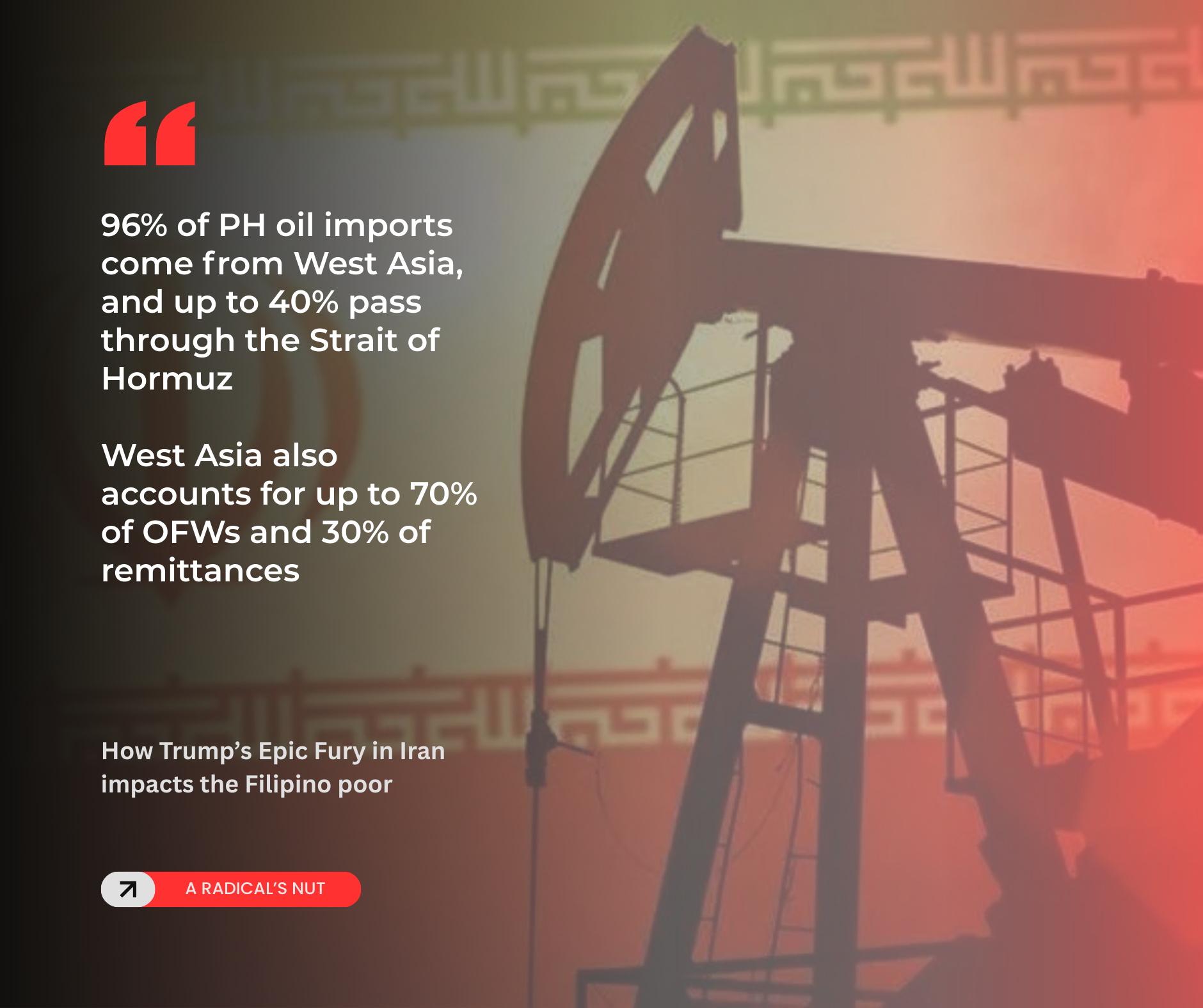
The Philippines imports practically 100% of its crude oil requirements. We are heavily dependent on two countries, Saudi Arabia (49%) and the UAE (28%). Iraq, which is not yet involved in the conflict, accounts for 19% of the total. In other words, 96% of the country’s crude oil imports come from only three countries, all in restive West Asia, with 77% from sources now directly involved in the conflict as hosts of US military bases.
Threats of actual supply disruptions are real, which spells a major problem for the Philippines. Around 20% of global oil exports pass through the Strait of Hormuz, a strategic chokepoint, including oil intended for the Philippines. Some 30-40% of Philippine oil imports pass through the Strait of Hormuz. Iran, which controls the northern side of the waterway, has warned commercial vessels that “no ship is allowed to pass” the Strait because of the insecure environment amid the US-Israel attacks. Major carriers have already paused operations through the Strait, after oil tankers near Oman were attacked. Major supply disruptions could paralyze a heavily import-dependent, oil-intensive Philippine economy.
Even prior to the attacks, there were already concerns that a US-Iran conflict could push global oil prices by up to $10 per barrel. Oil prices could spike further if the crisis worsens and the Strait of Hormuz is significantly shut down. Based on estimates, pump prices in the Philippines jump by P2.50 to P4.00 per liter for every $10-per-barrel increase in crude oil prices. Such a price hike does not yet reflect the impact of peso depreciation, which remains a high possibility given the growing uncertainties due to the crisis. A weak peso will compound the problem of rising pump prices. Overall, a $10-per-barrel global crude price hike could affect the economy, consuming 400,000 to 450,000 bpd of oil, resulting in an annual outflow of $1.46 billion (more than P84 billion).
Filipino households ultimately shoulder this impact through higher consumer prices, including increased transport fares and food costs, and through greatly reduced household purchasing power. A $10-per-barrel increase in crude oil prices translates into a 0.3 to 0.5 percentage-point increase in the country’s inflation over time, disproportionately affecting the poorest households. The poorest 10% of Filipino households could lose almost 3% of their already low income, while the richest 10% could lose less than 1 percent.
Remember that the downstream Philippine oil industry has been privatized and deregulated in the past thirty years, carried out in the name of neoliberal reforms championed by US-led global financial institutions, the International Monetary Fund (IMF) and the World Bank. As such, oil companies can automatically and fully pass on the burden of oil price shocks to consumers, without any meaningful or effective government intervention.
OFW remittances
The underdeveloped Philippine economy, which lacks the basic industries to generate jobs at home and whose devastated agriculture no longer has the capacity to provide livelihoods, has relied on labor exports and migrant workers’ remittances to keep the economy afloat for the past half-century.
Overseas Filipino Workers (OFWs) are heavily concentrated in West Asia. The region accounts for 65-70% of newly deployed land-based OFWs worldwide each year. West Asia also accounts for 55-65% of all OFWs worldwide at any given time. Around 25-30% of OFW remittances come from the region.
Remittances comprise a significant portion of the national economy and are a major driver of spending capacity. Annual remittances from overseas workers account for 8-9% of the country’s gross domestic product (GDP) and account for 10-12% of total household income nationwide. In the most remittance-dependent regions, such as Ilocos, Central Luzon, Calabarzon, and parts of Mindanao, migrant remittances account for 20-30% of household income.
The US-Israel war on Iran and its escalation will seriously undermine a major income source for many Filipino households, not to mention putting in grave danger the lives of OFWs deployed in West Asia. Saudi Arabia hosts 800,000 to 900,000 OFWs; UAE (600,000 to 700,000); Qatar (260,000); Kuwait (250,000); Bahrain (50,000); and Israel (30,000). There are around a thousand OFWs in Iran. This means that 1.5 to 2 million Filipinos are exposed to various levels of risk. Even an optimistic assumption that the US-Israel imperialist war only affects 10% of the OFWs in the region, that is still 150,000 to 200,000 Filipinos that the government may need to evacuate, a potential humanitarian crisis, and a major macroeconomic vulnerability for the Philippines.
Based on remittance and deployment figures, let us assume that each OFW in West Asia remits $5,000 annually. Disruption of remittance affecting 10% of OFWs deployed in the region for a certain period, say six months, is already equivalent to $500 million in income losses. Even in a more optimistic scenario in which no major evacuation is needed and no consequent disruption of remittances for an extended period, OFWs and their families still face the prospect of lower income due to reduced working hours, workplace suspensions, or employer distress. Each OFW supports a household of an average of five members, meaning hundreds of thousands to millions of Filipinos are affected domestically (e.g., a 10% evacuation of OFWs could affect up to one million Filipinos at home). Combine this with the economic impacts of rising oil prices because of the Iran crisis, and we have a very volatile situation in the country, more than 7,000 kilometers away from the conflict zone.
No to US imperialist wars and military presence
It is not in the Filipino people’s interest to support the imperialist agenda of the US, whether in West Asia or here in our region. Beyond the grave economic consequences of the Iran crisis, the retaliatory attacks that Iran launched targeting American military bases and facilities across the Gulf should compel the Marcos Jr. regime rethink the country’s military agreements with the US that allow American troops and weapons to be stationed in the Philippines. Under the Enhanced Defense Cooperation Agreement (EDCA), US troops maintain military facilities in nine locations across the country. Moreover, the Marcos Jr. regime has also permitted the stationing of US mid-range Typhon missile systems and NMESIS anti-ship missile platforms in the country, with additional deployments expected. This year, the US revealed plans to further expand its advanced missile technology and unmanned systems presence in the Philippines. Meanwhile, American military drones continue to operate across a wide area, from Mindanao to the South China Sea.
By accommodating multiple US military facilities and weapons platforms, the Philippines exposes itself to becoming a potential target in conflicts involving the US. As tensions rise across the Asia Pacific amid Washington’s increasingly aggressive assertion of its hegemony, the country faces the danger of being pulled into wars that are not of its own choosing, largely because it serves as a launch point and operational base for US troops.
The Filipino people have nothing to gain and are, in fact, adversely affected in various ways by the imperialist wars of aggression that the US wages to assert its hegemony. We must oppose the US-Israel war on Iran and join the growing global calls for an immediate cessation of military operations in West Asia for the sake of ordinary Iranians and our own interests, including those of our OFWs. We must hold US imperialism and Israeli Zionism accountable for the massive destruction and loss of life they are inflicting on the Iranian people to advance their regime change agenda, in serious violation of Iran’s national sovereignty and right to self-determination.
We should uphold an independent foreign policy that puts peace and regional stability first, grounded in mutual respect among nations. This means ensuring that our land is never used as a launchpad for imperialist wars and conflicts that threaten our people and erode our national sovereignty.

 A Radical's Nut
What do you think?