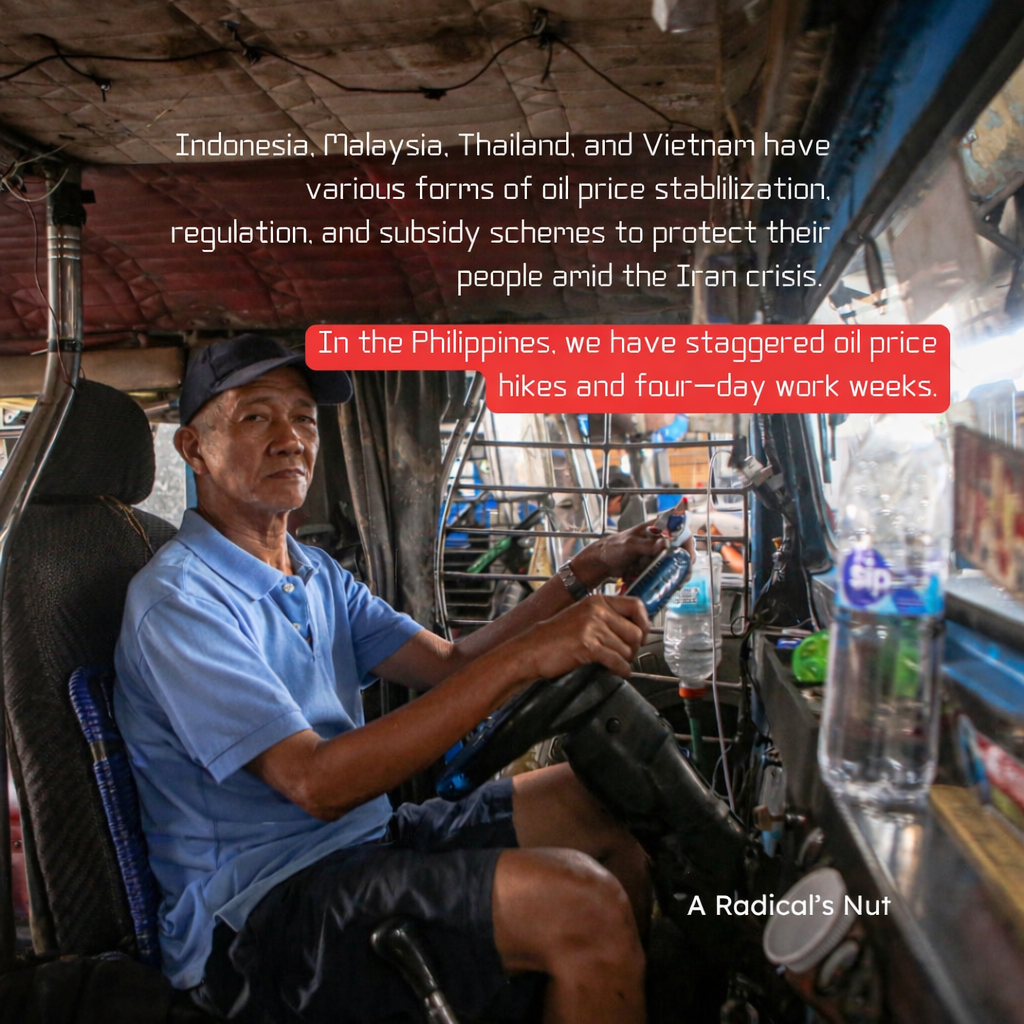
The escalating conflict in Iran and West Asia has once again exposed a fundamental weakness of the Philippine oil regime: the country’s complete exposure to global oil price shocks under the Downstream Oil Industry Deregulation Act of 1998 (the Oil Deregulation Law, or ODL). Compared to other countries in the region, we are one of the most vulnerable because the government, under the ODL, has given up all the important policy tools it could have used to effectively protect the public from extreme price spikes and supply insecurity.
Across Asia, many governments treat petroleum as a strategic commodity rather than an ordinary product left at the mercy of so-called market forces, as oil has become in the Philippines over the past three decades under deregulation. Policies range from heavy subsidies to managed pricing systems, but most countries retain mechanisms to shield consumers and economies from extreme volatility, even those that have introduced market-based pricing schemes or some form of deregulation.
The Philippines stands out for its fully deregulated downstream oil market, combined with very high import dependence and limited strategic reserves. These structural flaws leave the country particularly exposed to geopolitical shocks such as the current Iran crisis. Consequently, all Malacañang can do is to reduce the work week for government agencies, appeal to the oil companies to stagger the price hikes, or propose to cut the excise tax on petroleum products – all band-aid solutions given the magnitude of the crisis.
Automatic price adjustments
A key feature of the ODL is the mechanism that allows oil companies to adjust pump prices frequently in response to movements in international oil prices and foreign exchange rates. Supposedly, this ensures that domestic prices reflect global supply and demand conditions. In reality, however, it only means that Filipino consumers are immediately exposed to global price shocks, speculation, and profiteering.
Before the treacherous military assault by the US and Israel on Iran, domestic pump prices had already jumped (as of March 3 adjustments) by P6.70 per liter for gasoline, P7.70 per liter for kerosene, and P9.40 per liter for diesel. Because of the crisis, estimates indicate that pump prices could balloon by P11-13 per liter for gasoline, P21-23 per liter for diesel, and P33-35 per liter for kerosene. But these projected massive price hikes are much larger than what the actual supply-demand imbalance so far would justify. Most of the spike is being driven by war risk premiums, speculation, and supply-route fears reflecting perceived shortfall, not by a massive physical oil shortage yet.
Price adjustments of petroleum products in the Philippines are based on changes in the Mean of Platts Singapore (MOPS) benchmark, which is more volatile and more susceptible to speculation than crude price benchmarks. Since the attacks in Iran, for instance, the price of Dubai crude, the benchmark we use for pricing imported crude, has increased by more than 25 percent. Meanwhile, MOPS-linked gasoline and diesel prices have ballooned by more than 60 percent. For kerosene/jet fuel, the MOPS spot price has skyrocketed by a whopping 141 percent. The surge in MOPS benchmark prices is likely exaggerated, reaching levels that exceed what even a worst-case scenario, such as a prolonged effective closure of the Strait of Hormuz, would justify.
Under a deregulated regime, these speculative and overstated increases are quickly transmitted to domestic pump prices, resulting in price adjustments at gas stations that are often disproportionate to international market fundamentals. Oil firms announce weekly price adjustments based on the MOPS benchmark, passing on increases immediately and directly to consumers. This automatic transmission mechanism leaves Filipino households and businesses with little to no protection against the short-term volatility of global oil markets.
The Philippine oil market is especially vulnerable to the Iran crisis and its rapid spread across West Asia. We import practically 100% of our crude oil requirements. We are heavily dependent on just three West Asian countries, which account for 96% of our oil imports: Saudi Arabia (49%), the UAE (28%), and Iraq (19%). Some 30-40% of Philippine oil imports pass through the Strait of Hormuz, where shipping has been largely halted because of the ongoing war.
Buffering oil shocks: PH vs. Asia
The imperialist and Zionist agenda that drove the US and Israel to attack Iran cowardly, and the latter’s retaliatory attacks that targeted American military bases and facilities in Bahrain, Iraq, Jordan, Kuwait, Qatar, Saudi Arabia, and the UAE, are obviously beyond our control. What is within our control, however, are the policy tools that the government can use to protect the economy and the people from the sudden spikes in oil prices brought about by this imperialist war of aggression. Unfortunately, unlike other Asian countries, the Philippine government has long relinquished these policy tools in the name of full deregulation and structural adjustment pushed by the International Monetary Fund (IMF) and the World Bank in the 1990s.
What are some of these policy tools? One is a formal price regulatory process that includes public hearings and requires regulatory approval before oil companies can adjust pump prices, contrary to the current policy regime in the Philippines of automatic weekly price adjustments. This is the most direct approach to price regulation, which some Asian countries, even those that have partially liberalized their oil sector, still maintain to protect the public. In Bangladesh, a quasi-judicial regulator conducts public hearings and issues approval for changes in pump prices. In Vietnam, private oil companies propose adjustments in pump prices, which the government must approve before they can be implemented. The government can also delay or limit the increases if they threaten inflation or economic stability. In Indonesia, the government subsidizes, sets retail prices, and imposes price ceilings on diesel and other petroleum products, with the state-owned oil company adjusting prices based on government approval and fiscal considerations. In Malaysia, the government calculates allowable pump price adjustments based on global benchmarks but imposes a price cap or subsidizes them when international prices surge.
Many of the governments of our ASEAN neighbors maintain various price stabilization mechanisms to regulate prices in the interest of consumers. Thailand has the Oil Fuel Fund, which they use to cap diesel prices and subsidize fuel, while Vietnam has the Petroleum Price Stabilization Fund, where traders can draw to prevent retail price hikes. Indonesia and Malaysia maintain a subsidy system to cushion consumers when global prices surge and limit price hikes at their pump stations.
Aside from regulatory approval, subsidies, and caps, some Asian governments protect their domestic pump prices from speculative and volatile global prices by directly maintaining large strategic petroleum reserves. Japan, for example, has strategic reserves that could last for 254 days of domestic consumption, among the world’s largest, which it uses to stabilize domestic supply and prices during disruptions. The state-owned Japan Oil, Gas, and Metals National Corporation directly controls a volume equivalent to 153 days, while private oil firms hold the rest. In South Korea, the state-owned Korea National Oil Corporation maintains strategic reserves equivalent to 117 days of domestic consumption, in addition to the inventories of private oil players, which could last for 40-60 days. Unlike Japan and South Korea, the Philippine government does not maintain strategic petroleum reserves and, under deregulation, has relied on private oil companies to maintain commercial inventories, which currently stand at 50-60 days of domestic consumption. The government does not have effective control over the country’s petroleum supply or over how and when to release it to the market to stabilize pump prices or ensure national oil security in times of crises, such as the ongoing war in Iran. Some state-owned oil companies in ASEAN, such as those in Indonesia and Vietnam, are actively developing or building their national strategic petroleum reserves to protect energy security.
Making the situation worse for Filipino consumers is that the Philippine government imposes the highest taxes on petroleum products among Asian countries. Instead of proactively providing relief to the public, as many of its neighbors in the region do through a combination of price regulation, subsidies, caps, and strategic reserves, the government is aggravating the people’s burden with onerous taxes on petroleum, such as the 12% value-added tax (VAT) and excise tax. The Philippines has the highest oil VAT rate among ASEAN countries at 12%, compared to 7% in Thailand, 9% in Singapore, 10% in Cambodia, Laos, and Vietnam, and 11% in Indonesia. We even have a higher VAT rate than South Korea (10%) and Japan (10% VAT-like consumption tax), both of which have much more developed economies, and where consumers have much higher spending capacity.
Rethinking deregulation
Full deregulation of the Philippine downstream oil industry has left the country uniquely exposed to the harshest consequences of global oil volatility. Unlike our Asian neighbors, which have retained regulatory mechanisms, subsidies, price stabilization funds, or strategic reserves to cushion their economies and protect consumers, we have surrendered nearly all state policy tools in the name of neoliberal restructuring. This structural vulnerability is compounded by our near-total dependence on oil imports from a region that is forever made geopolitically unstable by the US imperialist agenda and interests.
The result is a system where speculative surges in international benchmarks are transmitted instantly and disproportionately to Filipino households, amplifying inflationary pressures, further undermining already deplorable living standards, and further weakening an already depressed national economy. The ongoing Iran crisis underscores the urgency of rethinking this framework: band-aid measures such as temporary tax cuts or appeals to oil companies can never substitute for a long-term national oil industry development program that serves the people.
If petroleum is to be treated as the strategic commodity that it truly is, then the Philippines must have the capacity to regulate prices, build national reserves, and deploy stabilization mechanisms, among other state policy tools, that prioritize public interest and welfare over unaccountable market forces and corporate profiteering. Without decisive reforms, the Philippines will remain perpetually at the mercy of external shocks, with the Filipino people bearing the brunt of every imperialist war and speculative frenzy in the global oil market. Let us call for immediate relief, such as scrapping the highly regressive oil VAT. But the real challenge is not simply to manage the current crisis, but to confront the deeper structural flaws of a deregulated oil industry.

 A Radical's Nut
What do you think?