Another round of big-time oil price hikes hit the hapless public transport drivers, private motorists, poor farmers and fishers, and consumers this week. Major oil companies announced that they increased the pump prices of diesel by P17.95 to P18.80 per liter, gasoline by P4.90 to P5.40 per liter, and kerosene by P8.10 per liter.
Before these recent increases, the price of diesel had already skyrocketed by P90.05 per liter; gasoline by P48.20; and kerosene by P78.10, based on the Department of Energy’s (DOE) Oil Monitor report as of March 31. This means that, since the start of the year, the pump price of diesel has already ballooned by more than P108 per liter amid the still escalating imperialist war that the US and Israel instigated against Iran. The pump price of gasoline has jumped by more than P53 per liter, and kerosene by more than P86 per liter. Compared with their levels at the start of the year, the price of diesel has now soared by a whopping 192%; gasoline (RON95) by 96%; and kerosene by 110%.
As expected, inflation accelerated sharply in March due to the global oil price shock. The Philippine Statistics Authority (PSA) reported that the inflation rate last month reached 4.1%, almost twice as fast as February’s 2.4%. The series of mega oil price hikes since the US-Israel war on Iran began accounted for 54.8% of the overall acceleration in inflation. Many jeepney drivers have stopped plying routes, and farmers are abandoning harvests because their livelihoods are no longer viable amid runaway fuel costs.
These unmitigated massive increases in fuel prices, among the worst in Asia and likely excessive and unjustifiable, are happening because of the Oil Deregulation Law (ODL). As explained in a previous article, under the ODL, the Philippine government dropped all the policy tools that could have been useful today to protect the Filipino people and the economy from the ongoing global oil price shock brought about by the US-Israel war on Iran, like what many of our neighbors in the region are doing.
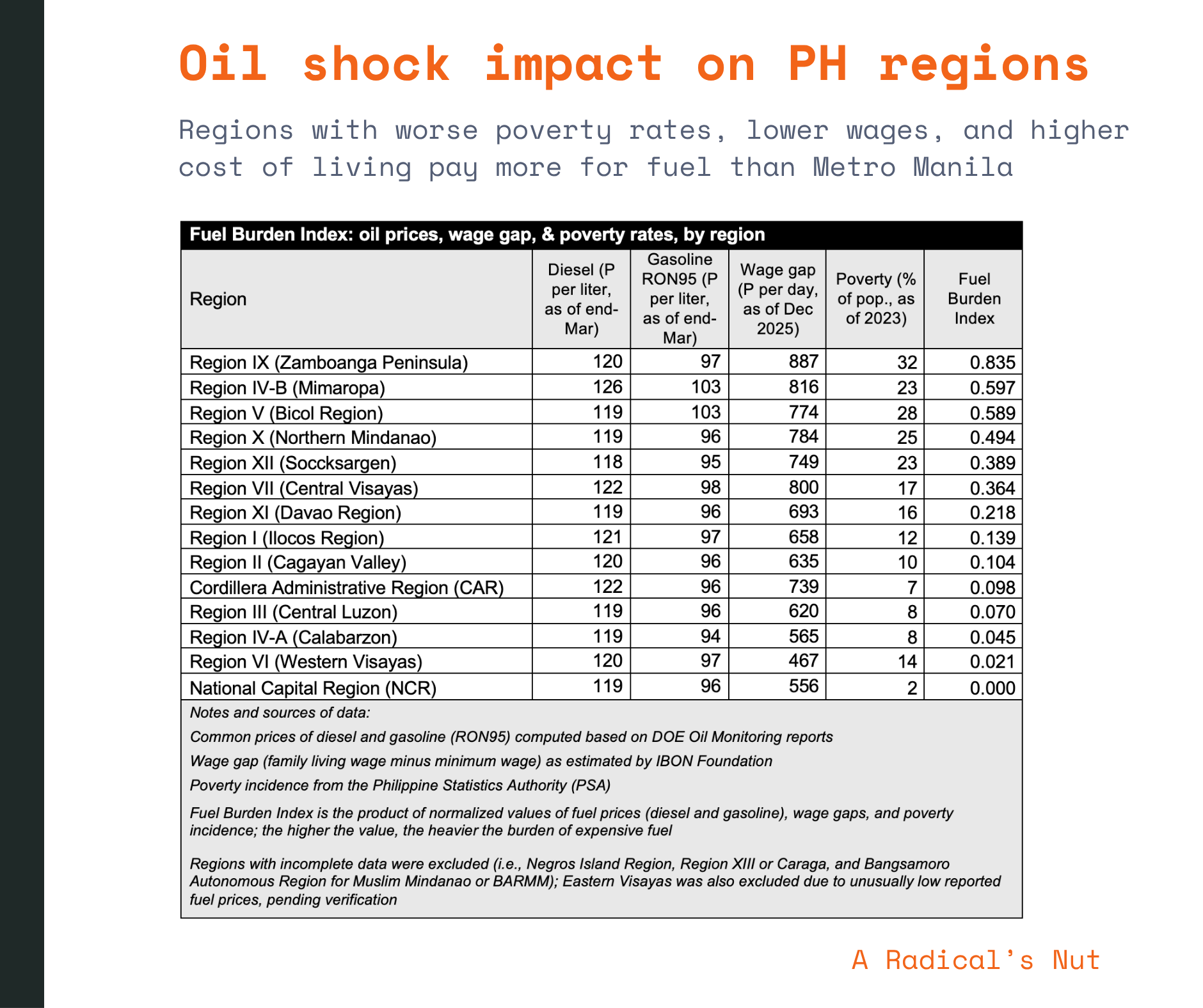
A closer look at how fuel prices interact with existing social conditions will further show how oppressive oil deregulation is. Using the Fuel Burden Index (FBIn), we can more clearly see how fuel price volatility disproportionately burdens the poorest regions in the Philippines, where wages are lowest, and the cost of living is highest.
The FBIn combines three key factors: fuel prices (diesel and gasoline RON95), regional wage gaps, and poverty incidence. Rather than treating fuel prices as a neutral, standalone variable, the index captures how these prices amplify pre-existing inequalities. In effect, it measures not just how high fuel prices are, but how socially damaging they become in different regional contexts.
Regions such as Zamboanga Peninsula, Mimaropa, and Bicol emerge as the most heavily impacted. These areas are characterized by a convergence of high poverty rates, wide wage disparities, and relatively elevated fuel prices. In contrast, regions like the National Capital Region (NCR), Central Luzon, and CALABARZON register lower impact scores, not because fuel is more affordable there, but because poverty incidence and wage gaps are less extreme than in other regions.
Zamboanga Peninsula registered the highest index by quite a significant margin. The region, which includes the provinces of Zamboanga del Norte, Zamboanga del Sur, and Zamboanga Sibugay, has the worst poverty incidence (32%) and the widest gap between its regional minimum wage and family living wage (P887 per day). At the same time, the region reported the fourth-highest diesel price (P120 per liter) and the third-highest gasoline price (P97 per liter).
Mimaropa, which ranked second behind Zamboanga Peninsula in the FBIn scores, reported the most expensive pump prices for both diesel (P126 per liter) and gasoline (P103 per liter), while posting the second-largest wage gap (P816 per day) and the fourth-highest poverty incidence (23%). The region comprises the provinces of Mindoro Occidental, Mindoro Oriental, Marinduque, Romblon, and Palawan.
Mindanao regions, where poverty rates and wage gaps have been historically high, suffer the worst impacts of the ongoing oil price shock. Four of the top six regions with the highest FBIn are from Mindanao: Zamboanga Peninsula, Northern Mindanao, Soccksargen, and Davao Region.
Oil deregulation intensifies the cost of living in already marginalized areas, raises transport and food prices, and deepens regional disparities. The FBIn makes this visible by showing that the burden of fuel costs is concentrated where people can least afford it.
Note on the Fuel Burden Index (FBIn)
The FBIn is a measure designed to capture the unequal social impact of fuel prices across regions. It combines three key variables: (1) fuel prices (using the average of diesel and gasoline prices), (2) wage gaps, and (3) poverty incidence.
Each variable is normalized to ensure comparability across regions. The index is then computed as the product of these normalized values. This means that regions with simultaneously high fuel prices, wide wage disparities, and high poverty incidence will register the highest scores.
The FBIn does not simply reflect price levels. Instead, it measures how fuel prices interact with underlying socio-economic conditions. In doing so, it highlights the regions where fuel costs are likely to impose the greatest burden on households.
A higher FBIn score indicates a stronger convergence of high prices, inequality, and poverty, signaling greater vulnerability to fuel price increases. Conversely, lower scores suggest that regions are relatively less affected, either due to lower poverty, narrower wage gaps, or both. ###

 A Radical's Nut
What do you think?