
In its August 13 editorial, the Philippine Daily Inquirer asked, “When it comes to toll fees, when is an increase ‘reasonable’ and when is it ‘stupefying’”? It argued that the South Luzon Tollway Corp. (SLTC) is entitled to a rate hike considering the “improvements it has done” to the South Luzon Expressway (SLEx).
The newspaper chided critics of the toll hike and reminded them that the cash-strapped government could not subsidize motorists using the expressway. The challenge to the Aquino administration, the editorial pointed out, is to “find that delicate balance” between the need of SLTC to recoup its investments and the need of the public for real relief. It then proposed to remove the 12 percent value added tax (VAT) from the new SLEx toll to “ease the burden on ordinary motorists”.
Still staggering
Removing the VAT, which in the first place should have been excluded from toll rates, will certainly provide immediate relief for some 300,000 motorists that use SLEx every day. Without the VAT, the new rates will go down by P10.2 (for cars and jeepneys) to almost P30.6 (for trailers and large trucks). But does removing the VAT make the SLEx toll hike acceptable and justified? Will the new rates be more reasonable and less stupefying? Taking away the VAT, SLEx toll will increase by 240 to 248 percent, which is still a staggering one-time increase by any standard.
SLTC’s supposed “entitlement” to a rate increase of such magnitude stems from the flawed policy of privatization of infrastructure development, or what President Noynoy Aquino calls Public-Private Partnership (P3). Privatized infrastructure narrowly measures the viability of a project in terms of how much and how fast the contractor will profit from his investment. On the contrary, publicly funded infrastructure measures a project’s success using a broader set of economic and social benefits.
Return on investment
Regulators, in evaluating the toll hike asked by SLTC, simply factored in the doubling of the number of lanes, the installation of TV cameras, and electronic collection system, among other physical improvements in the 27.3-kilometer superhighway. All these reportedly cost SLTC P11.8 billion, which it will recoup through a guaranteed 17 percent return on investment (ROI).
The guaranteed ROI is contained, according to news reports, in the February 2006 Supplemental Toll Operation Agreement (STOA) between SLTC and the Toll Regulatory Board (TRB). The 30-year STOA allows SLTC, which is 80 percent owned by Malaysia-based MTD Capital Bhd and 20 percent state-owned through the Philippine National Construction Corp. (PNCC), to rehabilitate and operate the SLEx.
ROI is a popular indicator used to calculate the profitability of an investment. In its broadest sense, it means total gain from investment (X) minus total cost of investment (Y) divided by total cost of investment (Y), thus: ROI = (X – Y) / Y. At an ROI of 17 percent annually and investment of P11.8 billion, the guaranteed profit of SLTC is pegged at not less than P2 billion a year for 30 years.
Guaranteed profits
With the newly approved toll, however, SLTC will apparently profit much more than P2 billion annually. At a traffic volume of 300,000 vehicles a day, SLTC will earn annual gross revenues of P11.79 billion (of which P1.41 billion will go to the VAT). This means that in one or two years, it can easily recoup its P11.8 billion investment and settle its liabilities, and then neatly profit from its monopoly of SLEx until 2036. See the table below.
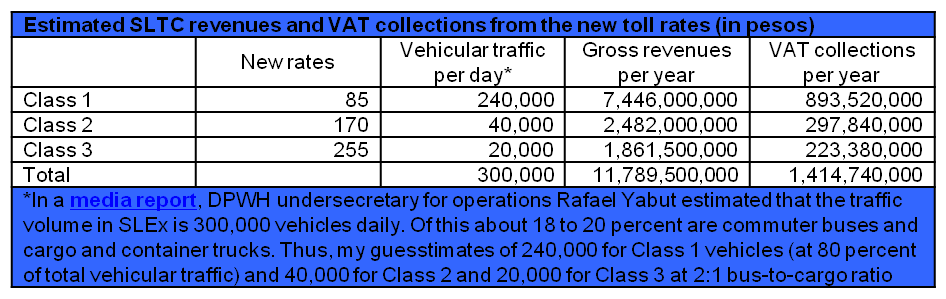
Of course, the projected P11.78 billion annual revenues will depreciate over time but it is more than compensated by the annual increase in vehicular traffic in SLEx, which some estimates peg at more than 10 percent a year.
The heavy focus on profitability that is inherent in any private enterprise instead of net economic and social gains make infrastructure projects pursued through P3s such as SLEx ultimately anti-development and anti-people, and therefore makes “that delicate balance” the Inquirer editorial is looking for practically impossible.
Zero ROI
On the other hand, a zero ROI is not necessarily bad in the context of core infrastructure like SLEx and other toll roads, MRT and LRT, water distribution, etc. that should be publicly controlled. According to the US Federal Geographic Data Committee (FGDC) in its paper “Economic Justification: Measuring Return on Investment (ROI) and Cost Benefit Analysis (CBA)”, while it takes an ROI ratio greater than zero to be attractive, “A sub-zero ratio may not automatically ‘kill’ a project, because it may result in a required capability that doesn’t currently exist”, said the FGDC. (FGDC is an interagency body that publishes the National Spatial Data Infrastructure.)
It further pointed out that “Not all government functions are required to have a positive rate of return as they are in the business world. Government is required to provide certain services to the public, and so is more tolerant of low ROI”.
Thus, if government did not privatize SLEx, there is room to compute its toll using a multi-faceted approach that takes into account not only the direct financial gains from the investment but indirect and long-term development gains as well. Note, for instance, that 60 percent of landed and export products to and from Luzon pass through the SLEx and as much as 20 percent of its traffic volume are commuter buses and cargo trucks. As such, it produces economic benefits for the country that are not captured by private profits.
Raising revenues
But the government is bankrupt and could not undertake infrastructure projects, proponents of P3s and privatization will claim. People’s organizations have long been campaigning for the de-liberalization of the economy, repeal of automatic debt servicing, cancellation of odious debt, etc. aside from curbing high-level bureaucratic corruption, tax evasion by the biggest foreign and local corporations, etc. to raise much needed revenues for infrastructure and other development and social needs of the country.
But the government is corrupt and inefficient unlike the private sector, privateers will argue. Should we then just allow the CEOs of Meralco, San Miguel, Metro Pacific, and the transnational corporations (TNCs) to run the government instead of elected political leaders? Practically, this has been already the case in the Philippines especially under imperialist globalization, and now more increasingly under the Aquino administration.
Concrete and doable alternatives to privatization are available. The neoliberal privateers should not be allowed to burden the people and undermine development with onerous and outrageously increasing user fees like the SLEx toll, or the MRT fare, water and power bills, etc. The privatization of development initiatives and state responsibilities must be stopped and reversed. The people and not the corporations should run the government.


 A Radical's Nut
Leave a reply to John Cancel reply