On June 8, Republic Act (RA) 9136 or the Electric Power Industry Reform Act (EPIRA) of 2001 will mark its tenth year. Former President Gloria Arroyo signed EPIRA amid strong opposition from various sectors. The manner in which the law was passed also controversial. There were claims of bribery involving half a billion pesos that the Arroyo administration allegedly handed out to members of the House of Representatives (HOR) to speed up the passage of EPIRA.
Proponents touted EPIRA as the answer to our power and fiscal woes. But after ten years, the country has now the most expensive electricity in Asia. Price manipulation besets the industry. Rotating brownouts plague Mindanao. And the National Power Corporation (NAPOCOR) remains neck-deep in debt.
What went wrong? The long and short of it is that EPIRA is a wrong policy.
Brief background
EPIRA provides the legal framework for the privatization of NAPOCOR and deregulation of the power industry. The state-owned power firm used to own and operate generation plants and transmission facilities. It also held supply contracts with independent power producers (IPPs), or private companies allowed by the Power Crisis Act of 1993 (RA 7648) and BOT Law of 1994 (RA 7718) to build and operate generation plants. Under EPIRA, the Power Sector Assets and Liabilities Management Corp. (PSALM) was set up to privatize the NAPOCOR’s generation and transmission assets including its IPP contracts.
The passage of EPIRA was a conditionality set by the creditors of NAPOCOR for it to access additional loans. Among its largest creditors were the Asian Development Bank (ADB), World Bank, and Japan Bank for International Cooperation (JBIC). These creditors were worried that NAPOCOR, with its worsening financial problems, might not be able to pay them back. The pressure from these creditors provided the impetus for EPIRA’s enactment.
After 10 years, PSALM has already privatized 91.7 percent of NAPOCOR’s generation assets in the Luzon and Visayas grid. It has also privatized almost two-thirds of energy outputs under IPP contracts nationwide. Transmission was privatized as well via a 25-year Concession Agreement (CA) between government and the National Grid Corporation of the Philippine (NGCP) in January 2009. As of October 2010, remaining assets for privatization include three generating assets (1,740.10 megawatts) and eight IPP contracts (2,026.32 MW).
Soaring rates
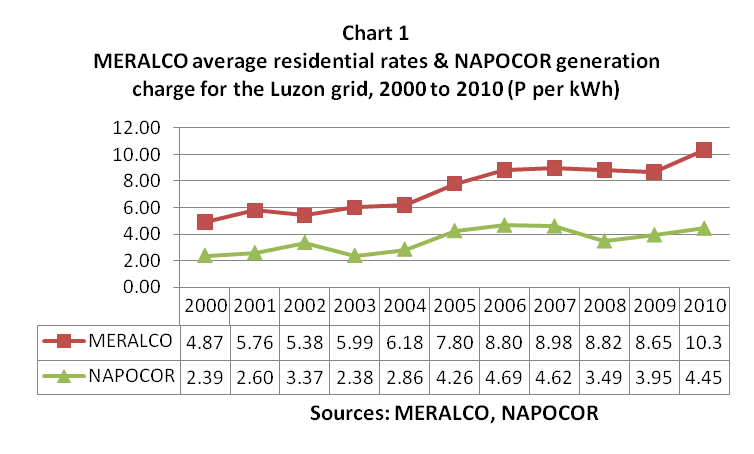
For consumers, the most obvious impact of EPIRA is the escalation in their monthly electricity bills. From 2001 to 2010, for example, the average residential rate of the Manila Electric Company (MERALCO) has increased by 112.5 percent. The generation charge of NAPOCOR for the Luzon grid has also risen by 86 percent during the same period. (See Chart 1)
Rates have soared because EPIRA allowed the continued collection of the notorious purchased power adjustment (PPA).The PPA was a pre-EPIRA cost recovery mechanism so that NAPOCOR can increase its rates and pay for its ballooning obligations arising from its take-or-pay contracts with the IPPs. Take-or-pay basically means that NAPOCOR will pay an IPP for a fixed capacity regardless if such capacity was used or not. For consumers, it means that they pay for electricity that they did not even use.
Under EPIRA, the PPA was just replaced with other means of cost recovery. One is the generation rate adjustment mechanism (GRAM) which NAPOCOR recoups every quarter although the amount must be approved first by the Energy Regulatory Commission (ERC). Meanwhile, DUs that have their own IPPs like MERALCO can automatically recover every month the change in generation cost thru the Automatic Adjustment of Generation Rates and Systems Loss Rates (AGRA).
Aside from GRAM and AGRA, consumers are also being burdened by the Incremental Currency Exchange Rate Adjustment (ICERA). Thru the ICERA, hapless end-users of electricity shoulder the losses of companies arising from fluctuations in the foreign exchange. To illustrate, if the cost of imported oil or coal used by generation companies went up because the peso- dollar exchange rate rose, the increment will be paid for by the consumers. Like the GRAM, ICERA is recovered quarterly and needs ERC consent.
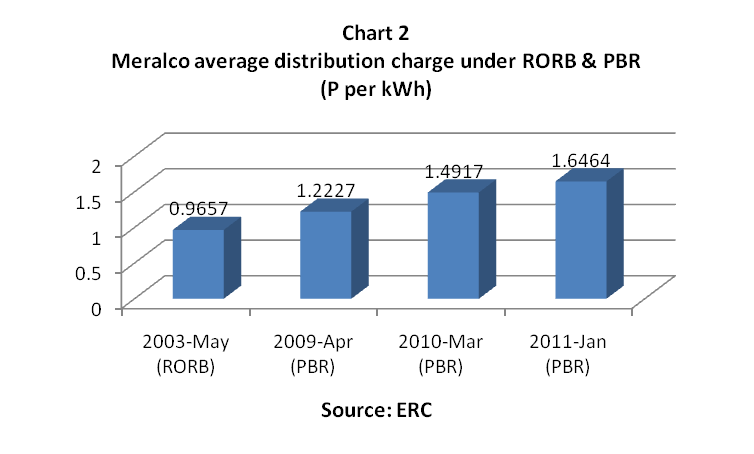
Consistent with the neoliberal agenda of EPIRA, the ERC adopted the performance-based regulation (PBR) in determining the rates of DUs. Before, DUs use the return on rate base (RORB) that pegged rates on “reasonable” return on the assets actually used in distributing electricity. The PBR, on the other hand, adheres to the principle that “good utility performance should lead to higher profits.” Thus, PBR allowed DUs to charge rates based on projected investments and operating expenses related to electricity distribution. Since using the PBR in 2009, MERALCO saw its distribution charge go up by 70.5 percent from its previous rate that used the RORB formula. (See Chart 2)
(Continued here)


 A Radical's Nut
Leave a reply to LPaulo Cancel reply