On September 10-11, the governments of the US, Japan, and the Philippines will co-host the Luzon Economic Corridor (LEC) Investment Forum. Sponsored by the US Trade and Development Agency (USTDA), the event is expected to bring together around 600 foreign investors, industry leaders, and senior government officials. Its stated objective is to “accelerate commercial partnerships and mobilize private sector investment across the LEC in the Philippines.”
But the forum is about more than promoting investments. The projects being assembled under the LEC reveal a broader US agenda to shape Philippine infrastructure, resources, technology, and industrial development in line with Washington’s strategic interests. The forum effectively serves as a marketplace where Philippine infrastructure and resources are packaged for foreign capital, while US government agencies help connect investors, technology providers, and Philippine corporations.
The USTDA is the principal organizer and strategic convener of the forum. It has curated a pipeline of high-priority, bankable infrastructure projects within the LEC to pitch to foreign investors, facilitate deal-making, and link project sponsors directly with international capital and US goods and services. Alongside senior Philippine government officials, the USTDA has brought together some of the country’s largest conglomerates and US companies with investments in the corridor to be the forum’s resource persons or speakers.
A major showcase of the forum is the US-led Pax Silica initiative and its planned Economic Security Zone (ESZ) in Capas, Tarlac. A dedicated forum discussion will examine how Pax Silica can “translate the LEC vision into investable projects” that strengthen supply-chain resilience, attract high-value investment, and position the Philippines as a hub for advanced manufacturing, trusted technology, and innovation.
This is significant because Pax Silica expands the LEC’s agenda beyond conventional infrastructure. It links the corridor to critical minerals, semiconductors, advanced manufacturing, strategic technologies, and the restructuring of global supply chains around US interests.
The forum will likewise showcase policy reforms undertaken by the Marcos government to make the country more attractive to foreign investors. These include Executive Order 122, which accelerates and expands mining of critical minerals relevant to Pax Silica. Investment opportunities will be promoted in transportation and logistics, energy security and industrial power, digital infrastructure, and advanced manufacturing. Prospective investors will also be taken on guided visits to major economic nodes, including Subic Bay, Clark City, and Batangas.
In this sense, the LEC Investment Forum functions as a US-backed open house for Philippine national patrimony and sovereignty. The Marcos regime and local oligarchs are effectively acting as real estate agents, rolling out the red carpet for foreign businesses to inspect, finance, and develop strategic Philippine assets and resources. Aside from the US and Japan, government partners include Australia, Canada, Denmark, the European Union, France, Italy, South Korea, Sweden, and the United Kingdom.
US capital, PH oligarchs
The central role of the USTDA underscores how state power and private enterprise intersect. The agency describes itself as the US government’s “first mover” in developing infrastructure abroad that is critical to US strategic interests while creating opportunities for American technology and innovation. It connects foreign governments with US corporations and finances feasibility studies, technical assistance, and pilot projects that define technology options, reduce investment risks, and help make infrastructure projects commercially viable.
The Subic-Clark-Manila-Batangas (SCMB) Freight Railway is a prime example. Envisioned as the LEC’s flagship transport project and structural backbone, the proposed 232-kilometer cargo railway would connect major deep-water ports and industrial zones, facilitating the movement of goods and integrating supply chains across the corridor.
The USTDA is providing technical assistance to the Department of Transportation (DOTr) on transportation modeling, port-rail integration, and legal and institutional planning. This assistance is intended to help the Philippines secure an Asian Development Bank (ADB) loan for construction. At the same time, the project creates opportunities for American companies to export rail technologies, equipment, and services.
The railway also illustrates how US-backed infrastructure development intersects with the interests of Philippine oligarchs. The SCMB Freight Railway is designed to connect the Subic and Manila terminals of Enrique Razon’s International Container Terminal Services Inc. (ICTSI), the country’s largest global port operator. ICTSI Group’s vice president is among the forum speakers, while another Razon company, Prime Infrastructure Capital, will be represented by its president and CEO.
Prime Infra is involved in major renewable energy projects that supply the Luzon grid, including the 600-MW Wawa hydropower project in Rizal, the 1,400-MW Ahunan hydropower project in Laguna, and a massive solar farm in Tarlac, a key geographic hub within the LEC.
The same pattern extends into energy and communications. The USTDA has ongoing partnerships with two of the Philippines’ largest corporations, Manny Pangilinan’s Meralco and Smart, involving the deployment of US nuclear technologies and the expansion of 5G services. These are precisely the types of energy and communications infrastructure needed to support the corridor’s industrial and technological ambitions. Meralco PowerGen Corp.’s president and CEO will speak at the forum.
The involvement of these companies is deliberate and strategic. The LEC is bringing together US government agencies that provide technical assistance, feasibility studies and pathways to financing; US corporations that provide capital, technology and services; and major Philippine conglomerates positioned to participate in and benefit from the resulting infrastructure projects.
This network becomes even more apparent in the LEC’s energy and logistics infrastructure.
The US State Department is supporting a technical and economic feasibility study for a proposed 72-kilometer fuel pipeline connecting Subic Bay with Basa Air Base, Clark International Airport, and New Clark City. Subic Bay already hosts a 6.3-million-barrel fuel storage facility, equivalent to roughly 20% of the country’s national import-storage capacity, operated by US private equity firm I Squared Capital. The firm is represented at the forum through its Senior Counsel for Strategic Initiatives and is working with the State Department and the Bases Conversion and Development Authority (BCDA) on the proposed pipeline.
With approximately $60 billion in assets under management, I Squared Capital is an important private sector partner in the Trump administration’s global infrastructure initiatives, with investments spanning energy, transportation, logistics, and digital infrastructure.
Its role in the LEC extends beyond fuel storage. The firm has invested in the rollout of 1,000 kilometers of fiber-optic network across Luzon, connecting major data centers, cable landing stations, and central business districts. It is working with BCDA, Smart, and Ayala’s Globe Telecom, whose chief financial officer is also a forum speaker, to strengthen digital connectivity within the LEC.
I Squared Capital is likewise working with the Ayala Group to support the corridor’s power requirements, including by operating a 150-MW modular diesel power plant in Rizal. Its investments extend into logistics, where it operates a network of cold-storage facilities in key distribution hubs linking Metro Manila with northern and southern Luzon.
The US government’s involvement also reaches into nuclear energy. The State Department is supporting, together with the Aboitiz Group and other partners, a training program on civil nuclear energy based on US small modular reactor (SMR) technology. One of Aboitiz’s directors is a speaker at the LEC Investment Forum. Other US investors with interests in the corridor are likewise represented, including Cerberus Capital Management, an American investment firm operating the Agila Subic Shipyard as a multipurpose logistics and industrial hub.
Collectively, these projects reveal a pattern under US direction. US government agencies help develop and de-risk projects; US capital and technology provide investment and infrastructure solutions; and major Philippine conglomerates become local corporate partners. The result is an infrastructure network increasingly integrated with foreign capital and strategic interests.
Beyond infra development
The LEC was established in April 2024 through a trilateral agreement between the US, Japan, and the Philippines. It is situated within a broader American strategy to counter China’s growing economic power and geopolitical influence.
Operating under the umbrella of the G7’s Partnership for Global Infrastructure and Investment (PGII), the LEC forms part of the Western response to China’s Belt and Road Initiative amid intensifying competition for resources, markets, and geopolitical influence.
Therefore, the corridor cannot be viewed solely as an economic or infrastructure development project. Beyond creating commercial opportunities for US industries, it forms part of Washington’s overall strategy in the Indo-Pacific, including efforts to strengthen the First Island Chain and contain China.
The geographical distribution of LEC projects is telling. Major infrastructure projects cluster around key US military sites and strategic facilities, including Enhanced Defense Cooperation Agreement (EDCA) locations, military exercise zones, naval docks, and airfields.
This gives the LEC a potential dual-use character. Railways, ports, airports, fuel facilities, and logistics networks can facilitate the movement of commercial goods, but they can also improve the movement of military supplies, equipment, and personnel. Digital infrastructure can support high-tech supply chains while providing communications networks relevant to defense operations. Advanced manufacturing and semiconductor facilities can likewise serve both civilian and military requirements.
Pax Silica’s ESZ, now called Clark Advanced Manufacturing Park by the BCDA, is particularly significant in this regard. Its focus on semiconductors and microchips places it at the intersection of commercial technology, strategic supply chains, and technologies with both civilian and military applications.
The LEC’s military dimension is not merely hypothetical. Major LEC hubs, especially Subic, are already assuming openly strategic functions for the US. The Agila Subic Shipyard, for instance, is being modernized as a strategic naval-industrial hub capable of manufacturing or servicing US and allied warships. The US also plans to establish an ammunition production and storage facility in Subic to address its lack of forward-staged ammunition infrastructure in the Indo-Pacific.
Thus, the physical infrastructure being developed under the LEC cannot be separated from the strategic geography in which it is being built. The same corridor that promises faster movement of goods and greater connectivity for investors can also provide logistical foundations for sustained US military operations and power projection.
An open house for foreign control
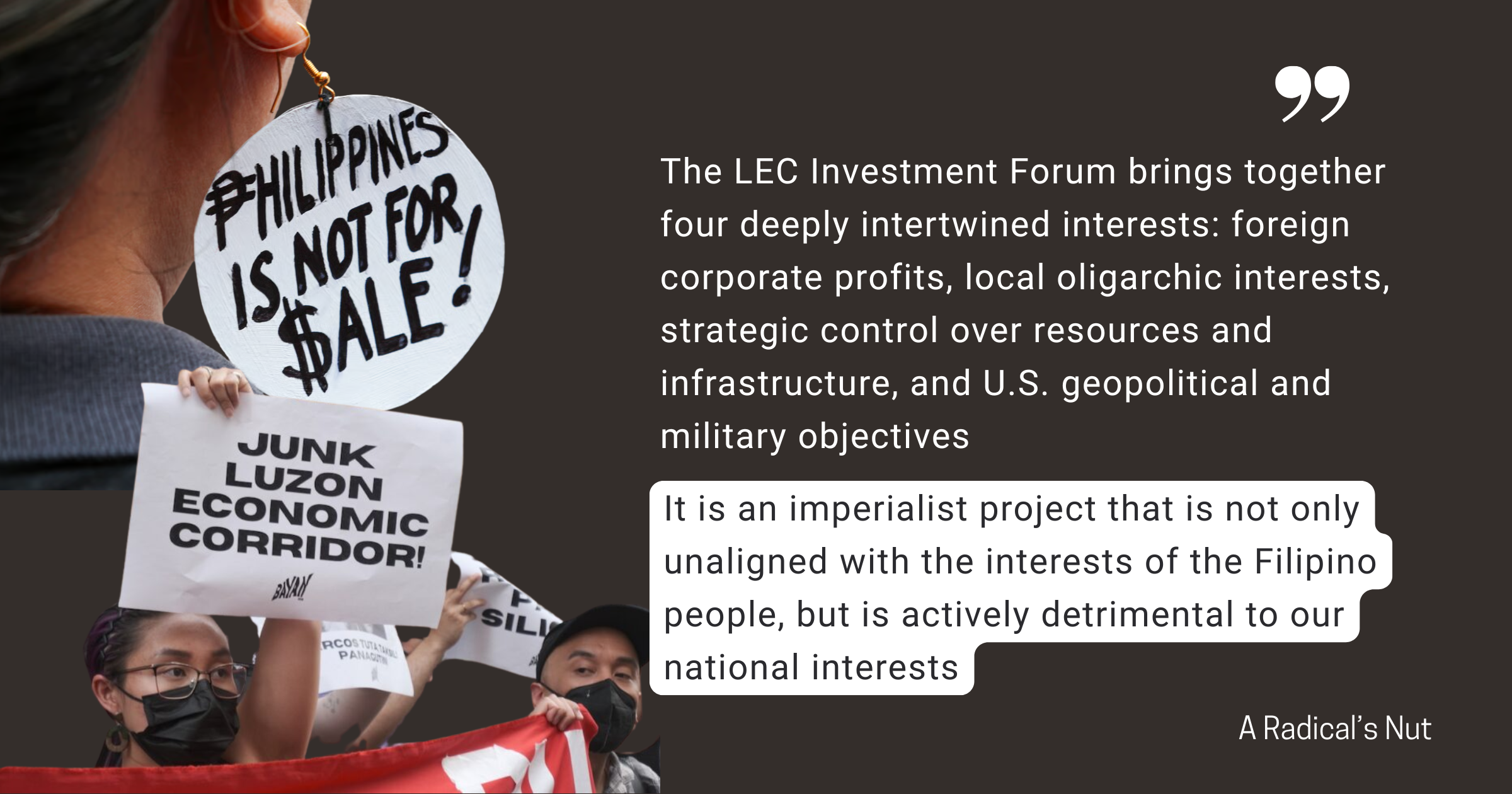
Ultimately, the LEC brings together four deeply intertwined interests: foreign corporate profits, Philippine oligarchic interests, strategic control over resources and infrastructure, and US geopolitical and military objectives. A bureaucracy that is subservient to US imperialism and representative of comprador interests is crucial, a role the Marcos regime has dutifully played.
Far from representing an independent path toward Philippine industrialization, the LEC risks deepening the country’s dependence on foreign capital and technology. It facilitates the extraction and control of natural resources, opens strategic infrastructure to foreign investment, creates captive markets for US technology and capital, and strengthens the logistical architecture supporting American military strategy.
The prominent role of US government agencies and corporations in financing, planning, and executing LEC projects raises a fundamental question: whose agenda does the corridor actually serve?
Genuine industrialization cannot be built by simply opening strategic infrastructure and natural resources to foreign investors. Nor can national development be secured by transforming Philippine territory into a platform for another power’s geopolitical ambitions.
The LEC Investment Forum is being presented as an opportunity to attract investment and spur much-needed industrialization. But behind the language of connectivity, resilience, innovation, and economic development lies a bigger imperialist project: to reorganize Philippine infrastructure, resources, technology, and territory in ways that serve foreign capital and the US strategic agenda.
For the country and our people, the issue is therefore not simply how much investment the LEC can attract. It is who will control the infrastructure, resources, technology, and economic direction that these investments create, and ultimately, who will benefit from them.
The LEC, as an imperialist project, is not only unaligned with the interests of the Filipino people but is actively detrimental to our national interests. The massive economic and physical dislocation of Indigenous and farming communities, the wanton plunder of resources and environmental destruction, and the country’s transformation into cannon fodder for US wars all provide compelling reasons to reject the LEC and declare that the Philippines is not for sale to any imperialist agenda. ###

 A Radical's Nut
What do you think?