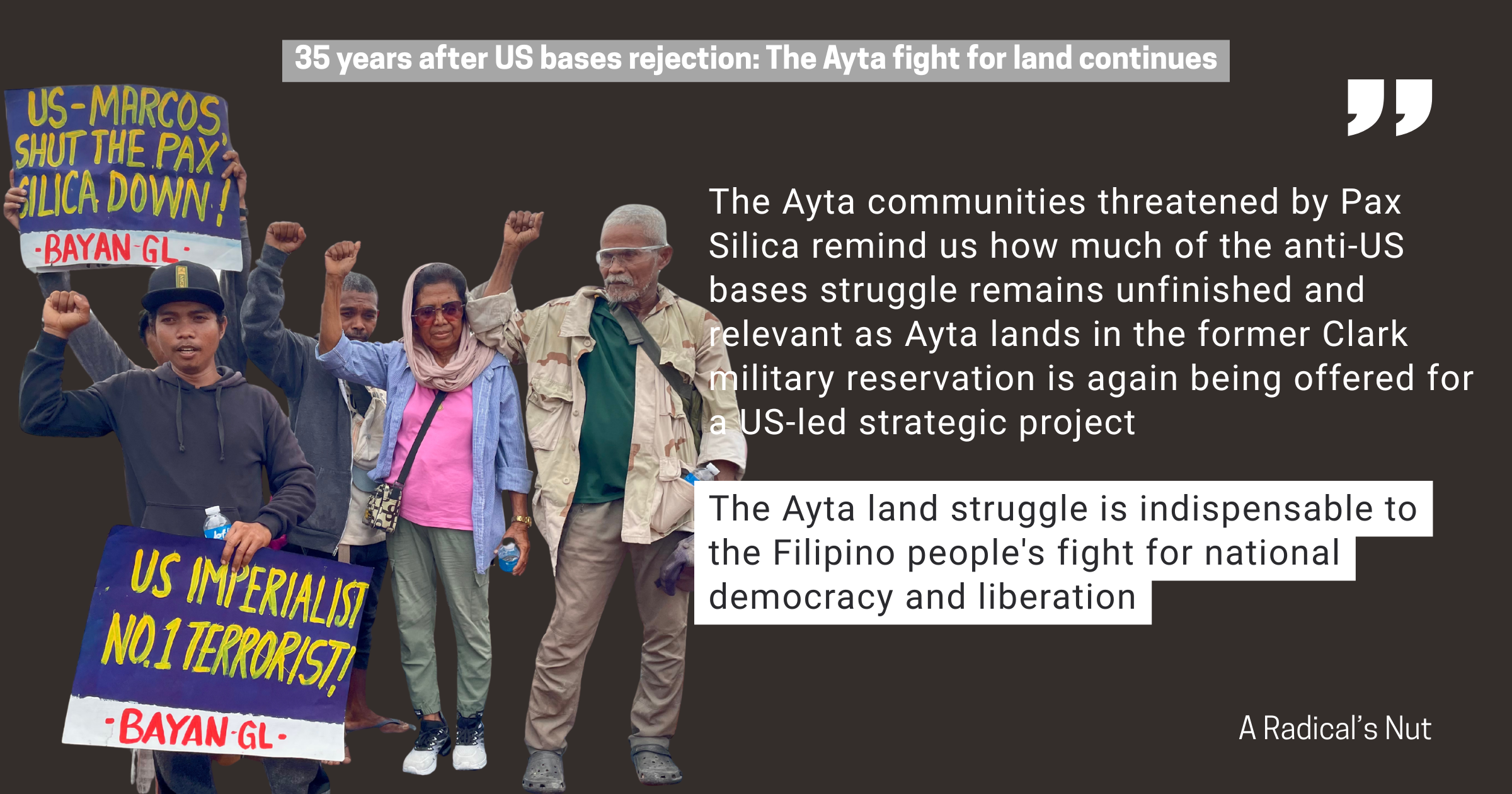
Thirty-five years ago, on September 16, 1991, the Philippine Senate rejected the Treaty of Friendship, Cooperation and Security that would have extended US use of Subic for another decade. Washington had already decided to abandon Clark after Mount Pinatubo’s eruption. At that time, Clark Air Base and Subic Naval Base were the largest foreign military bases of the US. The Senate vote, followed by the US withdrawal from Subic in 1992, marked a historic victory against the foreign bases.
Today, the Ayta communities threatened by Pax Silica remind us how much of that struggle remains unfinished and relevant. Land claimed by Indigenous peoples in the former Clark military reservation is again being offered for a US-led strategic project. The Marcos regime promises investments and industrial development. The Aytas face the prospect of another forced dislocation from their ancestral lands.
A century of dispossession
The oppression of the Aytas under US imperialism began long before the present controversy around the planned Clark Advanced Manufacturing Park of Pax Silica. The Americans established military installations on territories that had been inhabited and used by Ayta communities for centuries. Colonial power determined who held legitimate ownership and who could be forcibly displaced.
Under US colonialism, the establishment and expansion of Fort Stotsenburg and Clark displaced Aytas. Houses were destroyed and burned, residents threatened and harassed, and ancestral lands taken without compensation. Postwar base expansion brought further dislocations. In 1954, Subic’s expansion forced numerous Ayta communities into the New Cabalan reservation, while intensive bombing and target exercises in Crow Valley in Tarlac compelled others to abandon their lands.
The neocolonial contempt accompanying the Aytas’ dispossession was unmistakable. A January 11, 1983 circular from Subic’s Office of the Provost Marshal ordered the Aytas to remain in the jungle and keep out of public view around roads and the golf course. It threatened stricter enforcement if they failed to comply. The occupying power treated the original inhabitants as intruders, appropriating their land to accommodate American military bases and recreational grounds.
After the country’s nominal independence, the 1947 Military Bases Agreement preserved American access to Philippine territory. Puppet Philippine regimes helped maintain this arrangement. For communities dispossessed under colonial rule, neocolonial domination left intact a military presence that continued to restrict their access to ancestral lands and resources.
The rejection of the US bases in 1991 did not automatically restore the Ayta’s control over their ancestral territory. The Philippine state retained the power to determine how former military lands would be developed. Commercial conversion carried forward unresolved injustices.
Researchers working with communities around New Clark City documented the consequences of this continuing oppression and marginalization of the Aytas. Their participatory mapping challenged official portrayals of idle land, identifying productive farms, settlements, sacred grounds, and streams. They recorded bulldozed homes and fields, restricted communities, and threats to Indigenous livelihoods. The promised modern city was being built by destroying places where the Aytas already lived and worked.
Ancestral land for US interests
Pax Silica brings a renewed US strategic interest into this contested territory. Manila and Washington are pursuing a 1,620-hectare industrial hub within the Luzon Economic Corridor (LEC). The initiative seeks to organize AI and semiconductor supply chains among US allies and partners.
For the Aytas of Sapang Kawayan in Capas, Tarlac, the threat is immediate. Ayta leaders have called for the project’s cancellation and insisted that their communities will remain. Residents have reported being told to leave by December. They also fear for ancestral burial grounds. Forced relocation would uproot their livelihoods and sever ties to places that hold their culture and history. But communities should not have to wait for bulldozers to flatten their homes before their resistance is taken seriously.
The Bases Conversion and Development Authority (BCDA) argues that the project site is public land under its title and has no ancestral-domain title. It has disputed displacement estimates and offered assurances about livelihoods and jobs.
That response repeats the underlying historical social injustice. A state classification is invoked against a community whose claim rests on generations of occupation. The history of how ancestral territory became a military reservation is effectively erased from the discussion.
While the Indigenous Peoples’ Rights Act (IPRA) formally acknowledges native title and holistic ancestral domains, Indigenous advocacy groups have long criticized both the law and the National Commission on Indigenous Peoples (NCIP) for acting as mechanisms of state-sanctioned dispossession rather than true protections.
Critics point out that bureaucratic delays, such as leaving title applications unresolved for decades, are routinely weaponized to treat ancestral rights as negotiable or nonexistent when competing with state-backed developments. Free, Prior, and Informed Consent (FPIC) processes are similarly denounced by land defenders as corrupted rubber-stamping procedures designed to manipulate consent rather than enforce community veto power.
NCIP’s recent acknowledgment of threatened homes and livelihoods in Capas stems directly from public outrage and protests by affected Ayta communities, not because of a proactive performance of its mandate to protect Indigenous rights and welfare.
The BCDA and NCIP seek to reduce forced displacement to a matter of mere compensation. Yet the fundamental issue extends far beyond monetary settlement: Ayta communities are once again being coerced into surrendering the material basis of their existence as Washington secures technological supply chains and the Marcos regime offers up land to attract investment. This arrangement subordinates the future of the Ayta people and the rest of the nation to priorities set by a foreign power and implemented by its local agents.
As I have argued in my discussion of the Luzon Economic Corridor, economic infrastructure and US military strategy increasingly reinforce each other. Technologies and logistics serving commerce can also support military operations. Pax Silica must be examined within this wider drive to secure resources and technological advantage for US imperialism. Ayta land should never become another sacrifice to the endless imperialist drive for territories and spheres of influence.
The people can prevail
September 16 reminds us that resistance can win. The Senate vote emerged from a sustained people’s campaign against the US military bases. Organized public opposition helped make possible a decision that challenged Washington and the puppet regime’s support for continued US basing.
While that victory did not end US imperialist domination, it clearly demonstrated that even a powerful imperialist state can be forced to retreat. The lesson demands renewed organizing, mobilization, and solidarity with communities defending their land against a new wave of US imperialist war and plunder.
Shutting down Pax Silica requires unwavering support for the Aytas’ demand to uphold their ancestral lands and self-determination. The Ayta land struggle is indispensable to the Filipino people’s fight for national democracy and liberation. National freedom is meaningless unless Indigenous peoples control their own territories and futures; advancing their struggle carries forward the historic victory of September 16 against US imperialism. ###

 A Radical's Nut
What do you think?